

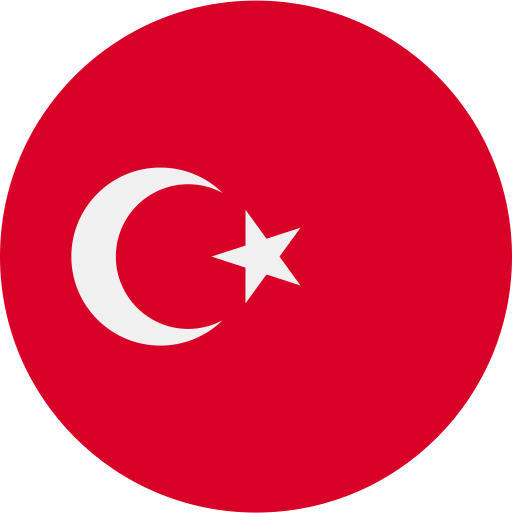
Turkey football traffic in the 2026/27 Season: how to plan content and campaigns around the Süper Lig, derbies, and key matches.
Turkey Football Traffic: Süper Lig guide for affiliates across the 2026/27 season
In 2026 Turkey Football Traffic fluctuates throughout the season: a regular match may sustain steady interest, while derbies, the start of the championship, or a decisive playoff series in the spring cause a sharp spike in search demand. That is why it’s better to plan Süper Lig traffic not as a single 9-month campaign, but as a series of separate windows. The Turkish football season 2026/27 provides affiliate projects with plenty of opportunities for this approach — from summer transfers and the opening rounds to the title race. The challenge is to prepare the necessary pages before a specific story begins to attract a mass audience.
Süper Lig 2026/27 Season at a Glance: mapping the main traffic windows
The new Süper Lig season should be viewed both as a football calendar and a roadmap for future demand. The championship is organized under the auspices of the Turkish Football Federation, and its structure creates many recurring news cycles.
For the affiliate plan, it’s convenient to divide the season into several segments:
- • preseason — transfers, rosters, and expectations;
- • August – September — the return of regular betting interest;
- • fall — stabilization of the standings and the first serious assessments of the clubs;
- • winter — the transfer window and roster changes;
- • March – May — the title race, European spots, and the fight to avoid relegation.
Within these segments, there are shorter peaks. These can be tracked separately:
- • matches between Galatasaray, Fenerbahçe, and Beşiktaş;
- • the return to action after international breaks;
- • the first matches after the transfer window;
- • changes in the league leader;
- • the final rounds.
For a Turkish-speaking audience, different phases require different content. In July, a user might be searching for a club’s new signings, whereas in April, they’ll already be interested in the standings, the competitors’ schedules, and possible scenarios for the season’s conclusion. A single evergreen page cannot cover all these search intentions.
Therefore, it’s also advisable to segment the content:
- 1. season hubs;
- 2. fixture pages;
- 3. club pages;
- 4. derby coverage;
- 5. standings-related content;
- 6. transfer updates;
- 7. match-specific landing pages.
Süper Lig traffic forms a separate category, driven by news rather than occurring immediately before kickoff. The transfer of a key forward, a coaching change, or a five-game winning streak can spike interest several days before the next match. If an affiliate only begins preparing a page on game day, part of the early search demand has already been lost.
It’s also helpful to distinguish between campaign timeframes:
- • 24–48 hours — ad-hoc match pages;
- • 1–3 weeks — derbies and major showdowns;
- • 2–3 months — the race for standings;
- • the entire season — club and league hubs.
As a result, the Turkish football league generates not just one major traffic spike, but dozens of waves of varying durations.
The Big Three Rivalry — Your Highest-Converting Traffic Window around turkey’s biggest derbies
Matches featuring Galatasaray, Fenerbahçe, and Beşiktaş generate a completely different level of attention than a regular league match. Interest begins to build well before kickoff: discussions about lineups, uniforms, and the history of the rivalry can boost Süper Lig traffic as early as 7–14 days in advance. For affiliates, this means a longer conversion window, during which a single event can support SEO, social media, and paid campaigns simultaneously.
It’s best to segment traffic around the Big Three by intent:
- 1. early — match date, lineups, previous results;
- 2. informational — team form and statistics;
- 3. commercial — odds, sportsbooks, and promotions;
- 4. matchday — starting lineups and latest updates;
- 5. post-match — result, standings, and upcoming matches.
It’s also best not to limit content to a single page. For a derby, you can prepare:
- 1. a central landing page;
- 2. a separate match preview;
- 3. a comparison of current offers;
- 4. a page with head-to-head statistics;
- 5. short posts for social media channels;
- 6. updates right before the game.
It makes sense to split the budget as well. 10–14 days before the match, the bulk of the work should focus on SEO and warming up the audience. 2–3 days before kickoff, you can ramp up paid traffic and retargeting, and on game day, concentrate spending on search queries with the strongest commercial intent.
For a Turkish-speaking audience, a localized approach is especially important. A generic text about the big match in Turkey pales in comparison to content that takes into account the specific derby, the previous matchup, the teams’ standings, and the current context of the season.
Another advantage of the Big Three is repeatability. Affiliates don’t have to start from scratch before every derby. Pages can be saved and updated with:
- • the date;
- • form;
- • standings;
- • lineups;
- • current promotions.
As a result, Turkey Football Traffic related to Galatasaray, Fenerbahçe, and Beşiktaş can be built up throughout the entire season. The most valuable aspect here isn’t a single evening with a large number of clicks, but the ability to launch a campaign in advance, bring it to a peak on match day, and leverage the accumulated audience after the final whistle.
Defending Champion Storyline — Galatasaray’s Title Defense as a season-long traffic hook
Galatasaray’s status as defending champion can be used as an overarching narrative that ties together dozens of individual news hooks. Instead of creating a campaign solely for a single match, the affiliate is presented with a simple question that remains relevant for many months: Will the reigning champion be able to hold onto first place? It is precisely this question that allows for regular updates on Süper Lig traffic without having to come up with a new topic every time.
At the start of the season, certain angles work well:
- • changes to the championship-winning roster;
- • summer transfers;
- • the first 5 matches;
- • new competitors;
- • opening odds for the title.
After a few months, the focus shifts:
- 1. their position in the standings;
- 2. winning streaks;
- 3. results against rivals;
- 4. injuries to key players;
- 5. the remaining schedule;
- 6. changes in title odds.
This structure effectively allows you to “parasitize” on the championship in a positive marketing sense: every new result for Galatasaray becomes a continuation of a story the user is already familiar with.
The greatest value of this storyline becomes apparent as spring approaches. If Galatasaray remains in the title race, each subsequent round gains additional context, and the 2026/27 Turkish football season gradually transforms from a long schedule into a concrete title race. By this point, the older pages already have a history, and the affiliate can direct the accumulated organic audience to fresh match pages and current offers. That’s exactly why the championship storyline should be launched right at the start of the season, rather than when there are only 4–5 rounds left until the finish.
European Competition Windows — A Secondary Traffic Spike beyond the domestic calendar
European competition weeks create an additional layer of traffic for Turkish football that overlaps with the regular Süper Lig schedule. Just 3–4 days later, the team returns to the domestic league, and its form, lineup rotation, and the result of the European match become part of a new news cycle. For affiliates, this is an opportunity to engage with the same audience twice within a short period.
This cycle can be broken down into several stages:
- • 2–3 days before the European match — a preview and current form;
- • matchday — real-time content and social media traffic;
- • the following day — the result and its implications;
- • before the next Süper Lig round — content about fatigue, rotation, and the return to the league.
You don’t necessarily have to create new content from scratch. A single club hub can link:
- • the European competition page;
- • the next Süper Lig match;
- • current form;
- • the schedule;
- • betting-related content.
Weeks when a European match is scheduled immediately before a derby become particularly interesting. In those cases, Süper Lig traffic begins to rise even before the international match ends. The focus is no longer limited to whether the club won or lost: users are looking at who played the full 90 minutes, who the coach kept on the bench, and whether the physical toll will affect the upcoming weekend.
Paid campaigns can also be segmented here. A broader reach is appropriate around the European match, while afterward, part of the budget can be shifted to retargeting users ahead of the domestic match. A single engaged visitor thus receives 2–3 relevant touchpoints per week.
For Turkey Football Traffic, European competitions therefore function not as competition for the Süper Lig, but as an additional catalyst. The best results occur when an affiliate links both calendars: a European match creates the initial surge, its result generates a new narrative, and the next round of the Turkish football league captures an audience that’s already engaged.
Building a Content & Campaign Calendar Around the Season instead of reacting match by match
It’s impractical to structure a full-season campaign in the same way from August through May.
Pre-Season: July to Mid-August. In July, there are no results from the new season yet, but there are plenty of news hooks. Now is the time to create pages that will be needed over the next 8–10 months.
Content foundation:
- 1. season preview;
- 2. transfers;
- 3. new team signings;
- 4. coaching changes;
- 5. projected title race;
- 6. club guides;
- 7. upcoming derbies.
This is where you should start your SEO work:
- • update old seasonal URLs;
- • create a hub for the 2026/27 season;
- • check internal linking;
- • prepare match page templates.
The main goal is to warm up the Turkish-speaking audience and prepare the pages for when Turkey Football Traffic spikes sharply after the season’s opening whistle.
Opening Weeks: August to September. The first rounds mark the return of users who barely followed betting content over the summer.
Key focus:
- • broad SEO topics;
- • short-form social content;
- • match previews;
- • promotions;
- • paid acquisition.
Campaigns can be divided into three categories: new audiences, users from last season, and visitors who have already viewed preseason pages. August and September, in particular, provide a good opportunity to build the audience base that the affiliate will work with in the fall.
Mid-Season Grind: October to December. By October, there’s no need to remind the audience that the season has begun.
Priorities shift to:
- 1. retargeting;
- 2. derby traffic;
- 3. segmentation based on past behavior.
During this period, Süper Lig traffic becomes more predictable. Instead of constantly expanding reach, you can focus more on bringing back existing users for specific matches and storylines.
Winter Break: Late December to Mid-January. A break in matches doesn’t have to mean a break in content.
During this time, the following topics are relevant:
- 1. early season recaps;
- 2. title race analysis;
- 3. the second-half schedule;
- 4. roster changes;
- 5. stories about winter training.
You can reduce your paid advertising budget while maintaining SEO, social media, and retention efforts. The goal for this period is simple: prevent the audience from completely dropping out of the funnel until matches resume.
Run-In & Title Race: March to May. In the spring, several storylines converge simultaneously: the championship race, European qualification spots, and the fight against relegation.
This is precisely where you can increase the budget:
- • paid search;
- • social campaigns;
- • retargeting;
- • derby pages;
- • title-race content;
- • matchday campaigns;
- • conversion-focused landing pages.
Turkey Football Traffic reaches its most commercially lucrative phase precisely when a single matchday can simultaneously shift the dynamics at both the top and bottom of the standings.
Best Traffic Sources for Turkish Football Betting Content across the season
SEO is best used as the foundation for schedules, club pages, derbies, and long-form seasonal stories, while social media is better suited for covering transfers, results, and news 24–48 hours before a match. Paid traffic can be leveraged more aggressively for major derbies and the spring title race, when commercial intent is noticeably higher.